Editor's Note: MFWire interrupts our regular news coverage to bring you this special annual April Fools' Day message from the folks at Fuse Research Network. If you need a few laughs and a break from the news, read on ...
| | Thomas Neil Bathon
Fuse Research Network
Founder, Partner | |
And yes, to be clear, this article is fake news. But what if ...
News You Can Use: Top News Items Selected by FUSE
Private Credit Firms Announce "Selective Liquidity" Strategy to Better Protect Retail Investors
New York, NY — A coalition of leading private credit managers today unveiled a revolutionary "Democratization-
Plus" framework, designed to ensure that the mass affluent remain invested in alternative assets regardless of their misguided personal preferences. Following a quarter where investors withdrew over $11 billion from the
sector, firms clarified that the "gates" currently blocking
two-thirds of redemption requests are not "restrictions" but rather "mandatory long-term commitment enhancements."
Wall Street Celebrates DoL's 401(k) "Personal Pension & Endowment Model" for Retail Investors
Washington, D.C. — Financial giants today lauded the
expansion of illiquid private investments into 401(k) plans, asserting that a middle manager in Dayton deserves the same "sophisticated" exposure to 10-year lockups as the Yale University Endowment. Proponents argue that by stripping away the "distraction" of daily
liquidity, they are helping retirees embrace the "patience" typically reserved for dynastic wealth. The
DoL seemingly went out of its way to reinforce the benevolent nature of the decision and indicated that no unintended consequences had yet to be identified. Ultimately, the industry remains committed to the belief
that if an ultra-high-net-worth individual enjoys the tax-optimized complexity of a Cayman Islands feeder fund, it will surely be the perfect solution for those with a median 401(k) account balance of $38,176.
Unmasking the ETF: The "Disruptor" Admits to Being a Mutual Fund Share Class All Along
Malvern, PA — The American Association of Individual Investors (
AAII) today officially ended what the
trade group calls the charade of the "independent" ETF marketplace, confirming that the vehicle's greatest innovation was simply being a tax-efficient appendage of its mutual fund parents all along. With the expiration of Vanguard's multi-class patent and recent regulatory
"breakthroughs," the revolutionary ETF has been firmly
reabsorbed into the old-school mutual fund business it once claimed it would disrupt. This structural homecoming reveals that the ETF's decade of "standalone" growth was effectively a masterclass in selling low-
cost beta.
Publicly Traded Corporations Hail Changes to Securities Exchange Act of 1934
New York, NY — Public companies today celebrated a groundbreaking push to abandon quarterly reporting requirements, finally admitting that the only thing standing between them and "private equity-style returns" is the inconvenience of informing analysts and shareholders of business results on an overly frequent basis.
Proponents argue that by moving to an annual disclosure model, public firms can finally achieve the "transparency-free alpha" long enjoyed by private firms. Using fully proprietary valuation algorithms, rather
than daily market pricing, will enable public companies to better reflect the true value of the company without the intrusion of market forces that do not properly reflect the real financial health of an organization.
McKinsey Consultants Alarmed to Find AI is Perfectly Mimicking Their Business Model
New York, NY —
McKinsey & Company associates are reportedly leading an internal revolt against the firm's AI
integration, citing a "deeply unsettling" discovery that LLMs can generate generic, unoriginal strategies and aesthetically pleasing PowerPoint decks at a fraction of the cost of their billable hour. Junior consultants, who previously spent eighty hours a week repackaging the client's own ideas into +$500,000 "strategic
frameworks," are calling for a total ban on the technology after realizing that AI's ability to actually craft a tactical execution plan makes it a significant competitor. On a related note, McKinsey has begun a major push to get firms to hire its "autonomous agents" so that these plants can then convince other virtual employees that the only way to survive is by bringing in their former McKinsey co-workers to assist with strategy projects.
The Wrapper Trap: Why the Active ETF Pivot is a Structural Mirage
The active management industry is currently treating the ETF wrapper like a "fountain of youth" for its aging, outflow-heavy legacy portfolios, but the makeover is skin-deep. While the tax-efficient pivot offers a short-
term structural advantage, the competitive advantage fades with each passing month as the ETF share class becomes ubiquitous. Once the use of the wrapper becomes fully commoditized, firms will again face the
reality of relativity (performance, risk, fees) and consistency. Having said that, trying to compete without an ETF version of a retail investment offering is a losing battle — even if you are specifically targeting the $15 trillion in the already tax-advantaged assets in 401(k) and IRA accounts — as financial advisors (and their platforms) put a premium on ease of use.
Regulatory Alert: The "Independence" Paradox and the Duty of Care
FINRA has opened a formal inquiry into a high-profile advisor team following their transition to an RIA firm, citing marketing materials that claim the move was necessary to "finally provide clients with superior,
unconstrained investment solutions." The investigation seeks to reconcile how these "essential" strategies — now being aggressively marketed as being in the clients' best interests — were previously withheld or deemed unsuitable during the team's decade-long tenure at their prior firm. Investigators are specifically
examining whether the team's sudden discovery of "better" products coincidentally aligns with the higher internal payouts or transition "bonuses" typical of such moves. This "delayed fiduciary awakening" raises
significant questions regarding the team's historical adherence to Suitability and Best Interest standards. Effectively, the firm must now explain if they were previously providing suboptimal advice by choice, or if their newfound "freedom" is simply a rebranding of identical business practices.
Asset Managers Add "Tariff Sensitivity Scores" to Fund Fact Sheets
With global trade tensions continuing to shape markets, several firms are considering adding a "Tariff Sensitivity Score" to fund fact sheets alongside traditional metrics like expense ratios and turnover. The rating
would estimate how exposed a portfolio is to potential tariffs, trade disputes, and sudden supply chain relocations. As tariff dollars are set to be refunded, this score has served as an inverse indicator of future enhanced cash flow with a
VanEck leveraged fund expected to be registered in the coming weeks.
$1,000 "Baby Accounts" Set to Create a Generation of Investors
Following the Trump administration's proposal to seed $1,000 investment accounts for every American newborn during 2025-2028, the wealth industry is preparing for what could be the largest account-opening initiative in history. The so-called "Baby Accounts" would introduce millions of Americans to investing from birth, potentially creating a generation experiencing market corrections before ever learning long division. Asset managers and custodial platforms are excited: nearly 4 million births per year could become millions of new clients who have ultra-long investment horizons and minimal liquidity needs or interest in paperwork. Operational teams are already tackling details like KYC for infants and whether newborns can qualify as accredited investors for private market allocations.
In Praise of the Obvious
Innovator ETFs has filed the
Focus On Obvious Leaders ETF (Ticker: FOOL), which invests in large U.S. companies with strong earnings growth, high profitability, and positive price momentum within the S&P 500 universe. FOOL embraces the idea that sometimes the smartest strategy is simply owning the obvious winners ... and having a memorable ticker.
NextShares Returns with Patent-Pending Estimated Daily LiquidityTM Innovation
Looking to accelerate the convergence of public and private markets,
NextShares has announced a new ETF structure featuring a patent-pending
Estimated Daily LiquidityTM process. The approach is designed to provide investors with exchange-traded access to private assets, while introducing a more "flexible interpretation" of daily liquidity and price discovery. Shares would trade on the exchange as normal, with the fund's NAV determined using a forward-looking pricing model incorporating comparable transactions, internal projections, and other market-informed assumptions to deliver a more proactive interpretation of fair value.
NextShares describes the innovation as "a natural next step" in expanding access to private markets, while maintaining "appropriate flexibility around the definition of liquidity."
OpenTable introduces Reservations for Interval Fund Liquidity
Tech platform
OpenTable, best known for its restaurant reservation booking system, has entered the asset management business with its latest offering. Investors can now use OpenTable to reserve liquidity for redeeming their interval fund holdings. The new functionality has been well received with some credit interval funds already seeing liquidity reservations fully booked through 2028.
New Survey Supports Private Markets in 401(k) Plans
Yet
another survey reports that retirement savers want private equity and private credit in 401(k) plans. The
Alliance of Alternative Managers Associations poll found that 100 percent of plan participants want "more than anything in the world" to see private market vehicles in 401(k) menus. And 98 percent said they "totally trust" private equity and private credit firms in matters of risk and suitability. One survey participant included a comment that seemed to echo the sentiment of the larger group: "I do not know what it is or how it works, but I want to make as much money as rich people."
Introducing: Tifen OmniSegTM — The Last Segmentation Platform You'll Ever Buy
After years of asset managers asking, "Why don't our data sources talk to each other?" a new fintech startup has finally solved it.
Tifen OmniSegTM seamlessly integrates your CRM, data packs, third-party data, internal sales notes, marketing automation platform, advisor behavior signals, coffee preferences, and — yes — even your wholesalers' gut instincts — into a single, unified view of the advisor. No more silos. No more
inconsistencies. No more excuses. With Tifen OmniSeg
TM, you'll finally be able to:
Build impact-oriented, actionable advisor segments that update in real time
Align sales and marketing around a single source of truth (version 7.3)
Play the NBA game with your highest-value opportunities
When asked what makes Tifen OmniSeg
TM different, the founders explained: "We're not just another platform.
We're a paradigm-shifting, AI-powered, advisor-centric ecosystem designed to unlock actionable insights across the full distribution lifecycle."
Envestnet Unveils Data Feed Showing Advisors Which Products They Almost Recommended
Envestnet announced a new analytics dashboard that captures products advisors hovered over, filtered, or briefly considered before selecting something else. Asset managers can now subscribe to near-miss distribution data, offering insight into lost shelf space at the point of decision. Early adopters in distribution say the data is "incredibly actionable," particularly when paired with follow-up campaigns targeting advisors
who were just one click away.
LPL Partners with FLX for Enhanced Due Diligence Questionnaire
As part of an enhanced platform review process,
LPL &
FLX have added a qualitative section assessing how well portfolio managers align with advisor preferences for communication style, market outlook delivery, and general "call energy." The update follows internal findings that advisors were more likely to allocate to
strategies where managers were described as decisive but approachable on quarterly webcasts. Asset managers are reportedly workshopping how to authentically demonstrate measured conviction with optional
humility ... which they are finding surprisingly difficult to achieve.
Asset Managers Boost AI Use in Surprising Ways
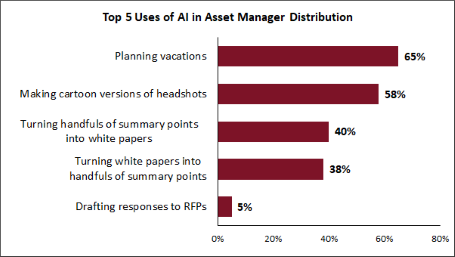
More asset managers are relying on AI in distribution, with the biggest increase in usage coming from vacation planning, which occurs at 65 percent of firms, up from 45 percent in 2024, a new
ISS /
Cogent survey finds. Making cartoons
out of professional headshots was the second most common use, seen at 23 percent of sales departments and 35 percent
of marketing teams — both increases from 2024. The only top-5 use that was unchanged from 2024 was using AI to draft responses to RFPs more quickly, steady at 5 percent of firms.
AI Added to Fund Name Immediately Improves Flows
Several asset managers announced plans to rename existing strategies to include "AI" somewhere in the fund name after
Cerulli's research revealed a strong correlation between artificial intelligence and investor inflows. One firm recently renamed its long-standing
Global Technology Fund to the
AI-Enhanced Global Innovation Fund, despite confirming that the portfolio holdings remain largely unchanged. "We believe artificial
intelligence will transform the economy," said the firm's head of marketing and innovation.
Tech Industry Shocked to Learn 'Scale' Also Applies to Consequences
ESG is once again in the headlines, propelled back into vogue by the rapid rise of AI. As adoption accelerates, so do concerns about its environmental footprint, from energy-intensive data centers to carbon emissions. At the same time, societal impacts — like workforce disruption and bias — are under scrutiny, alongside governance questions around transparency and accountability. Together, AI's far-reaching implications have reignited ESG as a central lens for evaluating innovation. News reports suggest that
SS&C is working with
BlackRock to determine if there is enough asset growth potential for Larry to reinstate his lifelong commitment to ESG.
Signal & Scroll Capital
A group of Stanford students has raised $200 million to launch what they describe as the next evolution in asset management: influencer-driven ETFs powered entirely by social commerce data. The newly formed firm,
Signal & Scroll Capital Management, will offer four actively managed ETFs built on proprietary AI models that scrape and analyze trends from TikTok Shop, Instagram Reels, and "high-conviction" influencer content. According to the founders, traditional financial data is "lagging, filtered, and emotionally detached," while influencer-driven purchasing behavior represents "real-time, high-intent consumer alpha." "If millions of
people are buying a product because someone said 'you need this,' that's not noise — that's signal," said the
firm's 19-year-old CEO, whose previous job was as ski instructor at St. Moritz Resort in Switzerland.
New ETF provider Complicate LLC filed to launch novel ETFs that enable investors to bet on forecasts of the growth of prediction markets. The Forecast Predictions ETFs will be available in six types of leveraged or
inverse strategies, as well as four types of buffered versions. Polymarket and Kalshi are already trading contracts betting on whether these get SEC approval. Tickers being considered include VIGS, LINE, EVNT, YESN, HNDL, BETZ, and BLJK.
Winner of "American Advisor Idol" Snags Record $20M Payout for Jumping BDs
In last night's nail-biter finale, veteran advisor Mike "Switch King" Reynolds was named champion of the industry's hottest new show, American Advisor Idol. After moving his $750 million book of business to a rival broker/dealer, Reynolds walked away with a record $20-million transition bonus. Interviewed from the deck of his new yacht, Reynolds stated, "I won this prize for my clients. Even though they get the same investments and service team, they gain an opportunity to submit new account opening forms and change their online passwords." Mike confirmed in a follow-up note that he has not yet sent out invites to clients to join him for a sunset cocktail cruise on his new boat.
Morningstar Announces "Sales-Alpha" Predictive Module: Finally, a Rating for the Rest of Us
Morningstar has officially unveiled its newest Direct add-on, the Distribution Destiny Score (DDS), a metric designed to save fund marketers from the inconvenient optimism of their own portfolio managers. Recognizing that a manager's belief in an "imminent 1-star turnaround" is a leading cause of wholesaler
burnout, the DDS bypasses traditional performance metrics in favor of "Market-Facing Viability Factors" — essentially a cold-blooded assessment of whether a fund can actually be sold to a human being in
the current calendar year. The proprietary algorithm weighs "Ticker Appeal," "Advisor Confirmation Bias," and "Structural Recency Effect" to provide a definitive focus-list ranking that no amount of PM hand-waving about "undervalued fundamentals" can refute.
Be Authentic. Just Like Everyone Else
Early research suggests the LinkedIn algorithm now rewards posts that are "authentic," "insightful," and somehow identical to everyone else's — ideally published at 8:17 am with 3 hashtags and a humblebrag about "what this moment taught me." Asset managers leaning in are seeing strong engagement from colleagues, former colleagues, vendors, and that one wholesaler who likes everything. LinkedIn is also suggesting that more work needs to be done around the optimal number of posts per week, as data shows requests to "de-link" skyrocket in only the 3rd round of 3 posts per week.
Activist Investor Charitable Capital Steps In to "Assist" Panicked Private Credit Shareholders
In a recent interview, Charitable Capital CEO Boza Weinberg warned that "the wheels are coming off" in the
private credit market, predicting many funds could be effectively worthless within the next several years as deteriorating credit quality and limited liquidity leave investors trapped in vehicles where redemptions are
increasingly prorated or suspended altogether. "Investors should be very scared — panic would be a perfectly rational response," Weinberg said, noting that while the outlook is grim, his firm is committed to helping shareholders in need. In what he described as an act of "corporate compassion," Charitable Capital has begun
offering liquidity through tender offers, generously allowing distressed investors to exit their positions at a very reasonable 43-percent discount to the last reported NAV. "Someone has to step up and provide liquidity," Weinberg added. "We're just trying to do the right thing."
FutureProof: Financial Services' Official Spring Break
What began as a forward-looking wealth and asset management conference has quietly become the industry's unofficial spring break. Advisors, asset managers, fintech founders, and media personalities now flock to the annual FutureProof Festival for what organizers call "an immersive professional experience." Panels on
portfolio construction, private markets, and AI now share the agenda with sunset concerts, poolside gatherings, early-morning wellness sessions, and networking that stretches well past the closing bell. One executive summarized: "Most conferences try to get you out of the bar and into the sessions. FutureProof does the opposite — if the bar is the session, attendance soars."
SEC Fast-Tracks Approval Process by Reviewing ETF Filings After Launch
In a move aimed at increasing innovation and reducing time-to-market for new products, the SEC has announced a revised review framework that will allow ETF issuers to launch funds prior to formal approval. Under the new "post-effective review" structure, filings will be evaluated on a rolling basis after assets have been raised and trading has commenced. The rule is being commonly referred to as the "SSIM IG" — not to be confused with the "SPDR SSGA Apollo IG" rule that was buried while being implemented.
Vanguard Announces Plans to Reintroduce Fees to Improve Client Experience
Vanguard has unveiled plans to reintroduce modest fees across select index products, citing a need to "restore a sense of value" among investors. The firm's leadership indicated that years of fee compression have led clients to underestimate the benefits of low-cost investing. "We believe that pricing should reflect not just
cost, but perceived worth," said a senior executive. 
Guest Column
Stay ahead of the news ... Sign up for our email alerts now
CLICK HERE


 Subscribe to MFWire.com's News Alerts [click]

 Email & Route
  Print
Print 

 Raw XML